|
|
Artikel from Stripschrift nr. 193/194 (march/april 1985) by Rob van Eijck
HIP Comics: American superheroes conquer the Netherlands
|
© Bart Bethlehem |
The first wave of American superheroes dates back to around 1938 when Superman was born, until the end of the forties, and it left the Netherlands almost untouched.
Superman briefly appeared in Robbedoes during and shortly after the war, but what about Captain America, Batman, The Submariner, The Human Torch, and all those other costumed power figures in the Netherlands?
Nothing. Clearly, the time was not yet ripe for this group of carnival-like strongmen who dressed in outfits that only a drunken toddler would dare to wear in public.
The Netherlands had to wait for the second wave of superhero popularity, which began to emerge in the United States in the early sixties with the introduction of Marvel heroes like Spider-Man and The Fantastic Four. This second wave brought new elements to the superhero comic.
The heroes were no longer just brute fighting machines; they also introduced a kind of quirky humor known as "camp," and they became much more human. They had private lives and associated personal problems. The superheroes were no longer as superhuman, and this may have contributed to the second wave of popularity, especially among older and more educated readers. In any case, their popularity was undeniable, so it's no wonder that a Dutch publisher, who already imported much from America, also brought superheroes to the Netherlands.
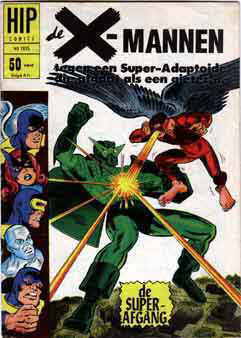
And so, in 1966, the first HIP Comics appeared (a name I objected to even then), featuring initially the two top Marvel series, Spider-Man and The Fantastic Four, trying to become as popular in the Netherlands as they were in America. Classics Nederland applied the same proven procedure in HIP Comics as Marvel did in the United States with Amazing Adventures and other magazines. These magazines didn't have a fixed main character but were used as a kind of testing ground for new heroes. If a hero proved to be popular, they got their own series. We can see this working method in HIP Comics as well. Initially, Spider-Man and The Fantastic Four took turns in each episode, but soon, in short stories at the end of the comics, The Hulk, Iron Man, The Submariner, and Thor appeared, and they were later given the honor of filling their own issues of HIP Comics.
In addition to these, the X-Men and the Avengers joined, and the publisher apparently had enough confidence in their performances that they didn't have to test them in short stories but immediately gave them their own comics. With the arrival of all these new costumed power figures, the frequency of Spider-Man and The Fantastic Four was slightly reduced, but they were still seen as the flagship characters.
They usually appeared in every fourth issue, while the rest of the characters appeared on average every eighth issue. As a testing ground, HIP Comics can certainly be considered successful because almost all of these superheroes got their own series. An interesting fact is that when all the superheroes that were well-received by the audience got their own series, the base series that launched them came to an end in 1971.
The adventures of superheroes introduced on a large scale in the Netherlands through HIP Comics differ from the experiences of 'ordinary' comic book heroes mainly in terms of quantity.
They are superheroes, and their adventures involve more than just solving a simple detective case, tracking missing persons in unclear circumstances, securing a disputed inheritance, or scoring goals in a soccer match. The goals they set often involve saving the entire Earth, or even entire solar systems, and the villains they must fight often have powers that match or even surpass the already considerable abilities of the superheroes.
This is the essence of a superhero: they must possess superhuman powers at the very least. This makes them akin to the ancient gods and demigods from the mythologies of earlier cultures.
The creators of superhero comics must have realized this as well, as they brought the entire Old Scandinavian godly world into Thor, placing it on an equal footing with all their self-created heroes.
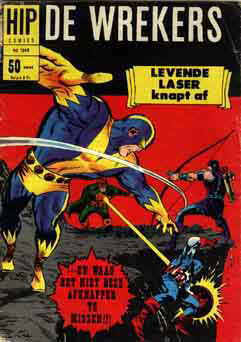
Another important feature of superheroes is that they dress in brightly colored, fantasy costumes, sometimes emphasizing their specific super abilities, and they often, but not necessarily, have a secret identity. In their daily lives, they lead unassuming, sometimes even modest existences, and in their immediate surroundings, almost no one is aware of their secret life as a superhero.
The first wave of superheroes likely owed its popularity to the period of chaos and conflict that the world, and after some hesitation, the United States found itself in during the Second World War. "American values" had to be defended against forces that sought to control and even destroy the world, and it was a titanic struggle for which superheroes were exceptionally qualified. When the war ended and its aftermath subsided, the popularity of superheroes waned; their presence was no longer necessary. The second wave of superhero popularity in the early sixties is more difficult to explain.
The cause could perhaps be sought in the increased fear of global destruction by "the bomb," especially fueled by the Cuban Missile Crisis in 1962 when superpowers teetered on the brink of nuclear war. World destruction seemed very close, and perhaps the activities of superheroes like The Fantastic Four, who were almost constantly thwarting evil plans for world destruction, were a reflection of and defense against these deep-rooted fears.
The superheroes of the second wave are different from those of the first.
The old heroes usually just went on a wild rampage to solve all sorts of problems, and there was rarely any psychological depth to their stories. The new heroes clearly surpass their predecessors in this regard. They are not averse to going on a wild rampage, think of The Thing from The Fantastic Four, but they don't stop there, as the old heroes did. There is humor in their adventures, sometimes ironic humor and self-deprecation. They don't always take themselves too seriously, and at times, the genre itself is satirized, making it a parody of the superhero theme.
Additionally, the new heroes are much more human. They struggle with various personal difficulties, have relationship problems, or are otherwise dissatisfied with their situation, like the Hulk and The Thing, who don't want to be superheroes at all.
Perhaps the most problematic case is Spider-Man, whose private life is a complete mess. This is likely the reason why he, an antihero, gained immense popularity on American campuses in the late sixties. These problems and frustrations make the new heroes more relatable to readers because they can identify more easily with them, much more so than with the blunt fighting machines from the first wave of superheroes.
Captain America, who was once the personification of the unshakable self-confidence of the American in their own norms and values and who was an even clearer advocate for law and order in society than the other superheroes, illustrates how far these problems and frustrations can go. Even he, by the end of the sixties, had doubts about American patriotism, as shown in the following comic strip.
|
|
The Legal Stuff: All pictures, logos and characters are Trademarks of their respective owners and are used without permission. Use of said trade marks, characters and logos does not constitute a violation of statutory rights, since they are not used for commercial purposes. Users of this site are requested to respect this tenet.
|