The nationwide success of SUPERMAN at "Ehapa" didn't happen entirely without support. The "BildSchriften Verlag"," known primarily by the acronym "BSV" printed on the covers, not only brought a whole array of American superheroes to German comic readers but didn't rely solely on licenses from the market giant "DC." Most importantly, the 1966 debut of the "Hit-Comics" label, which coincided with SUPERMAN's "Ehapa" debut, was significant.
In this initially black-and-white comic series, the most important characters from the big American "DC" competitor, "Marvel," exclusively appeared. They achieved true triumphs in their home country, mainly because their superheroes had to deal with real issues like rent debts and similar, which naturally increased identification opportunities. Furthermore, their actions were often artistically exaggerated to the point that they looked both breathtakingly explosive and grotesquely ironic. The master of this style, which quickly became a typical hallmark, the "Marvel style," was the long-time industry professional, Jack Kirby, who had taken over the design of most titles.
But ironically, the most popular of these new heroes did not come from his pen: SPIDER-MAN (then written by Stan Lee and illustrated by Steve Ditko) made his German debut in September 1966 with issue number 29 in "Hit-Comics," a year after the original American edition was published. In contrast to the all-powerful SUPERMAN, the human arachnid was genuinely unusual: Spidey's youthful alter ego, Peter Parker, not only constantly worried about his aunt May's heart condition but also faced public misunderstanding and persecution.
The second "Hit-Comic" presented THE FANTASTIC FOUR. The series that, in 1961, gave birth to the unique superhero cosmos of "Marvel" comics. A hero combo dressed in blue, with superpowers resulting from an accident involving cosmic radiation, corresponding to the four elements: Reed Richards, the stretchable MR. FANTASTIC (MR. FANTASTIC) represented the flexibility of water; Sue Storm, THE INVISIBLE GIRL, was transparent like air, while her brother Johnny Storm, THE HUMAN TORCH, represented fire. Finally, Ben Grimm, the disfigured stone monster THE THING symbolized the primal power of the Earth.
Up to issue 22, THE FANTASTIC FOUR alternated regularly with SPIDER-MAN.
Then, with issue number 23, THE AVENGERS were introduced to German comic fans. The superhero team, consisting of loners like THOR, IRON MAN, ANT-MAN, and WASP, among others, conveniently introduced readers to additional characters from the "Marvel Universe." In the USA, it was the other way around: fans were already familiar with all the team members before they formed the group in September 1963.
But even in the "Hit-Comics," they eventually had their own adventures. With issue 120, THOR and, later, with issue number 127, IRON MAN. Only ANT-MAN, who soon became GIANT-MAN, appeared sporadically as a backup story, mainly in later issues of THE FANTASTIC FOUR.
Besides, five other "Marvel" series adorned the covers of "Hit-Comics": X-MEN, THE HULK (written as HALK in German, according to the American pronunciation), DAREDEVIL (known as DEVIL-MAN), CAPTAIN MARVEL, and finally SUB-MARINER (known as PRINZ NAMOR).
DEVIL-MAN was later renamed DER DÄMON and even had its own numbering from 1 to 4. The X-MEN series was changed to X-MENSCHEN in the later issues 216-220, and Jean Grey, the telekinetic MARVEL-GIRL, was introduced to the team. Issues 216 and 217 were drawn by Neal Adams, who revolutionized superhero comics with his realistic style, particularly his work on GREEN LANTERN at "DC."
A total of 238 issues were published until the "Hit-Comics" were discontinued in 1973.
The "BSV" publisher had an unconventional publishing policy, not only with wooden translations and sometimes completely wrong coloring but also in terms of the titles. Unlike their American counterparts, the individual titles rarely had a reasonable relationship with each other. Sometimes, they announced sequels that were never published. Additionally, the stories were published in an arbitrary order: stories from the early 70s frequently alternated with those from the 60s, noticeable to readers due to changes in drawing style and a completely different narrative structure, without any apparent justification from the publisher. Lastly, the character origin stories, and thus their figurative context, were often provided only as an afterthought. This deprived the well-structured "Marvel Universe" in the USA, where nearly every event had an internal reference to previous and subsequent events, of its unique charm.
It wasn't until 1974, when the publisher was renamed "Williams" and the "Marvel" program was relaunched, that they addressed these issues. Many of the black-and-white stories from the "Hit-Comics" were reprinted in color and better translated. However, not all of them were reprinted. Especially later issues of X-MENSCHEN, IRON MAN, and the second stories featuring GIANT-MAN (formerly ANT-MAN) were missing.
But before this happened, "BSV" introduced other saviors from different publishers. For example, MIRACLE MAN, a rather silly SHAZAM knock-off, which ran for 25 issues from 1966 to 1969. On the other hand, THE OWL (1969) only managed to publish 2 issues. The American counterpart, THE OWL, was published by "Gold Key," known for successful TV adaptations like STAR TREK. Notably, THE OWL was written by Jerry Siegel, one of the two co-creators of SUPERMAN.
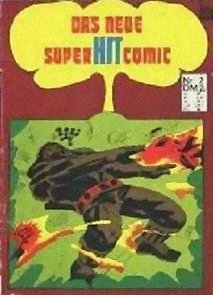
Another "Gold Key" series, GREEN HORNET, was published by "BSV" for only three issues from 1968 to 1969, titled DIE GRÜNE HORNISSE. This series was the complete run available. In the USA, THE GREEN HORNET gained some popularity due to the TV series of the same name, with Clayton Moore wearing the mask. Interestingly, the same producer also created the simultaneous BATMAN TV series, which was a pure parody, unlike GREEN HORNET. In one episode, Britt Reid and Kato, the Green Hornet and his sidekick, made a guest appearance.
Also from "Gold Key" comes DOCTOR SOLAR (MAN OF THE ATOM), who had a small revival in the USA in the 1980s and was reintroduced by the independent publisher "Valiant" in the early 1990s. In Germany, DOCTOR SOLAR had 24 issues published by "BSV," just like the series MAGNUS (also from "Gold Key"), which was particularly notable at the beginning for its elaborate, painted covers.
MAGNUS, created by TARZAN artist Russ Manning, was launched in Germany in 1966 and ran for 4 years and 25 issues. However, this series doesn't fall into the classic superhero category. MAGNUS doesn't have a secret identity, and he doesn't go on nightly patrols. Instead, he prevents self-thinking robots on Earth in the future.
In a somewhat similar vein, "Gold Key's" THE MIGHTY SAMSON, known as SAMSON in Germany, operated. However, while MAGNUS depicted the Earth's future as a technological "paradise" where a decadent humanity had become overly dependent on its robots, the archaic SAMSON used his superhuman strength in a post-apocalyptic world that had regressed to a state of barbarism after World War III. Both MAGNUS and SAMSON can only be loosely categorized as superheroes. The series ran from 1966 to 1970, with 16 issues in the case of SAMSON. Some of SAMSON's adventures were reprinted in the UFO pocketbooks of the "Condor" publishing house in the late 1970s and early 1980s.
Venturing into the periphery of the superhero world, other titles became possible. Not only did TARZAN become famous in the "Bildschriftenverlag" in July 1965, following its establishment in Germany by "Mondial" and "Lehning" in the 1950s.
In the SHERIFF CLASSICS series (1964-1973), THE GHOST RIDER occasionally hid his true face behind a full-face mask and flowing cape.
The adventures of GHOST RIDER originated from Stan Lee and Marvel but only used the Wild West as a backdrop for nearly unchanged storytelling patterns of the superhero genre. However, the series wasn't very successful; it ended after just 7 issues in the USA. In contrast, the more successful Wild West stories of THE RAWHIDE KID, also published in the SHERIFF CLASSICS, had almost nothing to do with superheroes anymore.
Interestingly, the artist for this series was none other than Jack Kirby, who designed THE RAWHIDE KID for "Marvel" much the same as his numerous superhero titles. In the 1990s, the character was even integrated into the continuity of the "Marvel Universe" and made a brief appearance in FANTASTIC FOUR #405. Speaking of Westerns, the masked hero who hunted criminals with silver bullets and called out "Hi-Yo Silver" appeared in 19 volumes from 1969 to 1971 in the Federal Republic of Germany as EINSAMER REITER. Taken from the American "Gold Key" editions, the cover pictures featured photos from the LONE RANGER TV series with Clayton Moore. In the 1970s, many of the stories from "Ehapa" were re-released in a paperback and album series.
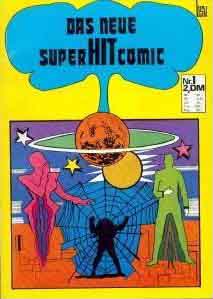
Encouraged by the success of "Hit-Comics," "BSV" soon tried its hand with two additional labels. Six new titles were introduced, five of which were pure superhero titles. However, unlike the "Hit-Comics," all of them were from the competitor "DC," putting them in direct competition with "Ehapa," which was using some of the same characters under different names in their SUPERMAN and MV COMIX publications. The first to arrive in 1968 were SUPER COMICS (30 issues in total), featuring the METAL MEN (created by Robert Kanigher) and METAMORPHO (created by Bob Haney).
Both series were extremely unusual and even bizarre, quickly gathering their own fan base in the USA due to their uniqueness. However, while METAMORPHO only managed 17 issues in the USA from 1965 to 1968, the METAL MEN had 41 issues from 1963 to January 1970 (the series was later continued in the USA with a different numbering).
METAMORPHO, subtitled as the "Lord of the Elements" by BSV, was a tragic hero, much like some of the "Marvel" characters. After a chemical accident, he could transform his body into almost anything imaginable, but Rex Mason, now called METAMORPHO, paid a high price: he was horribly disfigured. However, unlike many of his "Marvel" counterparts who had similar origins, like the HULK or the THING, METAMORPHO was less overtly portrayed as tragic. Despite its inner tragedy, his adventures contained such unique and parodistic elements that they gave rise to a fresh and unusual narrative logic, quite distinct from the repetitive themes of "Marvel" heroes.
The METAL MEN could also change their bodily forms at will but were intelligent androids, unlike METAMORPHO, who was once a human. The six robots created by Dr. Will Magnus each represented a different element: their leader was GOLD, and there was also PLATIN, LEAD, and so on. Doc Magnus was usually busy resisting the advances of PLATIN, who was madly in love with him, or repairing his creations that were damaged during missions. Once again, the German adaptation had issues with maintaining internal consistency. Some cover art of the METAL MEN didn't match the content inside the issues because they were taken from different original editions. For example, the second-to-last issue of "Super Comics," No. 29, which matched the content of the original American issue No. 37. While the American No. 37 featured one of the best cover artworks in the history of superhero comics, the German version used the cover image from the American issue No. 16, which, of course, had no connection to the story inside. And the story was unusual: the METAL MEN completely changed their appearance, making the robots indistinguishable from humans. In the USA, this transformation briefly stirred controversy but the series was temporarily halted with issue No. 41.
However, German readers remained unaware of this development! Although "Super Comics" No. 29 hinted at a continuation, the subsequent issue No. 30 corresponded to the completely unrelated American original issue No. 17.
In 1969, the "Bildschriftenverlag" introduced the "Top Comics." Unlike the "Super Comics," these comics were also going to experience four-color printing. That wasn't the only difference. The "Top Comics" mainly featured "regular" superheroes competing for readers' attention: BLACKHAWK (THE BLACK HAWK; issues 1, 5, 9, 13, 17, 100-121), AQUAMAN (WATERMAN; issues 2, 6, 10, 14, 18, 100-121), GREEN LANTERN (THE GREEN LANTERN; issues 3, 7, 11, 15, 19, 100-121), and the FLASH (BLITZMAN; issues 4, 8, 12, 16, 20, 100-121). While all of them divided issues 1-20 among themselves, the block of numbers 100-121 was allocated to each series, making later distinctions somewhat complicated – for example, issue 100 existed four times as a result.
"BSV" didn't meticulously adhere to the chronology of the original issues here either, but they were notably closer. The initial issues of the BLITZMAN, GREEN LANTERN, and WATERMAN series were noteworthy for featuring rare stories from the experimental US series SHOWCASE, where all three heroes made their debuts before eventually getting their own series due to their tremendous success.
It wasn't until the early 1970s, when the "Top Comics" began appearing in color, that classic material was mixed with modern stories. This was particularly appreciated in the case of GREEN LANTERN: although not in its entirety, some portions of issues 76-89, illustrated by Neal Adams and written by Denny O'Neil, which were produced in the USA from 1970 to 1972, were published.
These stories featured the all-powerful superhero confronting the social reality of the "American Dream" in a radical manner. To this day, these stories have not been reprinted or reworked in Germany. When the "Norbert Hethke Verlag" apparently wanted to start publishing these stories in its album series GRÜNE LATERNE KLASSIK in 1991, the publisher temporarily discontinued its entire "DC" program.
It's unclear why the "Bildschriftenverlag" included THE BLACK HAWK in its repertoire, especially considering that the series initially portrayed war experiences. Due to the authoritarian structure of the superhero group and their uniforms reminiscent of Nazis, it wasn't entirely unjustified to accuse the series of incorporating fascist elements. However, the internationally composed ensemble soon underwent significant changes.
The adventures became increasingly fantastical and exotic. Instead of dealing with wartime enemies, they now faced giants, bizarre robots, and peculiar inventions. In the original US issue 230, the adventurers briefly donned new costumes, transforming them into "true" superheroes for a few issues before returning to their original attire with issue 242.
None of these issues were published in Germany.
In 1973, "Top Comics" came to an end. Eventually, the "Bildschriftenverlag" bid farewell to comic fans. But not entirely. The name "Williams" would mark the beginning of an entirely new era in 1974, which would become synonymous with German superhero comics for many readers.
|